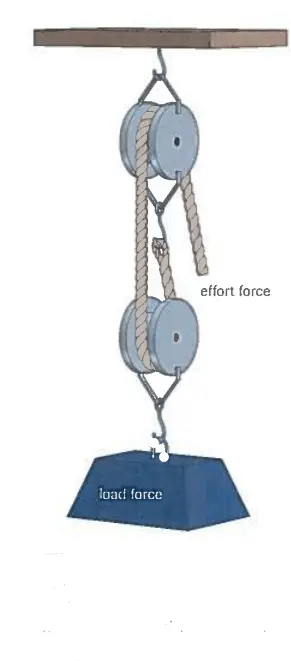
pulley systems: block and tackle
A block and tackle is a compact system of pulleys designed to raise heavy loads.
The block and tackle system has one cable or rope wound around two separate sets of pulleys. The pulleys of each set rotate freely on the same axle. The upper set is fixed to a support, and the lower set is attached to the load. Pulling the rope raises the lower set of pulleys, and thus raises the load.
The IMA of the block and tackle is equal to the total number of support strands of the cable. This type of machine is used in large cranes as well as in robotic devices.
In this simplified model of block and tackle (figure 1), a downward effort force on the rope causes the movable lower pulley to be raised toward the upper fixed pulley.